# Policy Library
# Employee Handbook
This Employee Handbook is a living document, chronicling the ways in which punctum books as a company operates vis-à-vis its employees.
# Employment Basics
#### Employment contract types
Full-time employees work 1 fte = 40 hours per week on average.
Part-time employees are those who work less than 1 fte per week.
Full-time and part-time employees can have either temporary or indefinite duration contracts.
Both full-time and part-time employees are eligible for our benefits package.
punctum books does not employ unpaid interns.
#### Equal opportunity employment
punctum books is a queer opportunity employer. Beyond the fact that we don’t tolerate discrimination against protected characteristics (gender, age, sexual orientation, race, nationality, ethnicity, religion, disability, veteran status), we intend to foster a workplace that is queer-friendly, embracing of emotional and neuro-diversity, and accommodating to a wide variety of relationship styles.
Discriminatory, offensive, or inappropriate behavior of any kind will not be tolerated. At the same time, we do not reinscribe the disciplinary structures of the state into our company's organization. All complaints will be discussed at a dedicated staff meeting, if necessary facilitated by an external impartial mediator. Issues between two or more employees are issues of the entire company.
#### Recruitment and selection process
Considering the small size of the our company, recruitment and hiring is managed by the Directors. In general, potential new hires will be slowly introduced to the company on a freelance basis with the prospect of a fixed contract.
New employees are vetted on their capabilities of operating independently within a small organization, their ability to take initiative, contribute to the scholarly and queer profile of the press, and have an excellent taste in music.
We do not run any background checks.
#### Onboarding
New employees are given logins and access to punctum's various production platforms, as required by their function. They will be issued logins and passwords. See further [Confidentiality and Data Protection](https://docs.punctumbooks.com/books/employee-handbook/page/confidentiality-and-data-protection).
#### Terms of Address, Accounts, and Identification
An employee has the right to be addressed by the name, pronouns, and title they request at all times, this includes non-binary/neo-pronouns and titles. This will be reflected in logins, email addresses, email signatures, and directories with the employee's correct name and title. For legal purposes, some systems (such as the payroll and health care) may require the employee's legal name. These should be considered an exception.
The intentional or persistent refusal to respect an employee’s gender identity (for example, intentionally referring to the employee by a name or pronoun that does not correspond to the employee’s wishes) can constitute harassment.
#### Attendance
Employees are autonomous in the organization of their working hours, as long as they are able to attend the weekly staff meeting and any other meetings with other employees and Directors that may be necessary for the satisfactory fulfillment of their task.
#### Weekly Staff Meeting and Other Meetings
punctum books does not have a central office space. As a result, the weekly online staff meeting, attended by the Directors and all employees has a core function in regulating the workflows within our company. The staff meeting starts with a check-in with everyone present, providing an overview of current tasks, ongoing production, and current or potential problems. Staff meetings will also present an opportunity for anyone to bring in new ideas, air grievances, or make proposals.
Other meetings between Directors and employees may be organized on a regular or ad-hoc basis, according to the exigencies of the production pipeline.
# Preface
punctum books’s employee handbook is a document that has been crafted with the help of our very own team members. This handbook is a flexible living document that will be endlessly iterated upon and improved over time. We have made all decisions regarding the content of this handbook collectively. We recognize that our team is made up of individuals with unique needs and perspectives and we will continue to revise and edit this handbook, to ensure that it remains relevant and useful to everyone as punctum continues togrow and flourish.
We will check in with everyone annually to ensure that the handbook is meeting our needs, and if any limit cases arise, we will come together as a consensus-based assembly to find a solution.
Thank you for your contributions to this handbook. We believe that it is a reflection of our shared values and a guide for us all as we continue to work towards our collective goals.
# Code of Conduct
All staff of punctum books is expected to abide by our general [Code of Conduct](https://docs.punctumbooks.com/books/code-of-conduct).
Furthermore, there are the following considerations.
### Dress code
punctum books is a sartorial powerhouse. We expect staff to have a well-honed personal fashion style that is coherent, remarkable, and individual. We are not interested in "business casual," any variety of standard academic attire, and scoff at minimalism. Extravagance in any way, including understatedness, is strongly supported.
### External Communication
There are several ways in which punctum books communicates with the outside world, including email and social media.
#### Email
When using punctum email, make sure to abide by the principles as laid out in the Code of Conduct. Treat anyone you email as a (future) member of the broader punctum community. We are known for our communicative style and this highly valued by the authors and editors we work with. We are flexible on deadlines, prompt in our answers, and generous in our advice.
Make sure that you have a footer in your email stating at least your name, preferred pronouns, business email address, social media handles (business and optionally personal). When you are away from your computer for more than a day, set an out of office message with emails of other staff or the Directors so emails are not falling into a black hole.
#### Social media
On your personal social media you should be able to express your own opinions. We don't ask you to say "my tweets are on a personal title" since that's the whole point of having a personal account. If you've been with us for while, your personal views, in any case, are most likely pretty close to what we believe collectively as a company. So post away and don't forget to tag us!
Also, do repost our punctum social media posts if you feel so inclined.
#### Gender Neutral Language
External communications should make use of gender neutral language where applicable. For example, when referring to an unknown individual the singular “they” should be used, rather than “he/she."
### Conflict of Interest
Let's discuss before employing relatives.
### Employee Relationships
While not prohibited, romantic and/or sexual relations between staff members are not encouraged. Besides the inevitable power dynamic at play in such relations and the messy entanglement of professional and private life, such relations and the resulotion of their potential difficulties on the short and medium term, tend to take up a lot of mental space within the organization, as everyone is grappling with new emotional balances. At the same time, such relations *do* happen and they are human. Let's treat them as humans.
### Workplace Visitors
Although we don't have a set "workplace," wherever we happen to work cute animals are welcome and small dogs are promoted. We welcome visitations of extraterrestrials.
### Spirituality
Even though punctum books has no set company religion, it venerates St. Barbara, the patron saint of those work with material and scholarly combustion. The name day of St. Barbara (December 4) is celebrated as a company-wide holiday. This, however, should not be construed as a sign of support for Christianity of any specific denomination or, indeed, of whichever other religious conviction.
# (Non-)Working Hours
### Working Hours
Working hours are a standard 40 hours per week. Staff is allowed to organize these hours throughout the week as they see fit, as long as this allows them to attend any necessary (online) meetings.
### Personal Time Off (PTO)
Staff has 20 days working days PTO, to be used anytime during the year. Please inform everyone when you intend to take some time off.
In the event that an employee expects an extended absence for longer than two weeks (e.g., long-term care of a loved one), and a full-time workload is not possible, the employee will bring this into discussion with the Directors. A solution regarding pay and full- or part-time workload will be reached and agreed upon by the Directors and the employee.
### Sick Days
Sick days do not count as PTO and will be paid. However, if you feel you will be absent from work for longer than 2 weeks we'll have to talk about how to deal with that. Longer illness-related absences will be discussed with the Directors and a solution regarding pay and full- or part-time workload will be reached and agreed upon by the Directors and the employee.
### Holidays
No national holidays, such as President's Day or C\*lumbus Day are observed. For the months February–November, staff collectively designates a Friday as holiday in that month to celebrate.
In April, we celebrate the founding of punctum books on April Fools Day.
In December, we celebrate the name day of St Barbara on the 14th.
#### Previous Holidays
2023
- February 17: International Cabbage Day
- March 24: National Cocktail Day
- April 9: National Unicorn Day
# Compensation and Benefits
#### Compensation
Baseline salaries are inflation-adjusted on an annual basis. An annual bonus is determined around December 1 based on the overall performance of the company, at the discretion of the Directors.
Employees are never required to work overtime but may do so at their own discretion. Continuous overtime work should be brought up in the weekly staff meeting, as it can lead to burnout.
Payroll automatically runs on the first of each month for the preceding month.
#### Healthcare
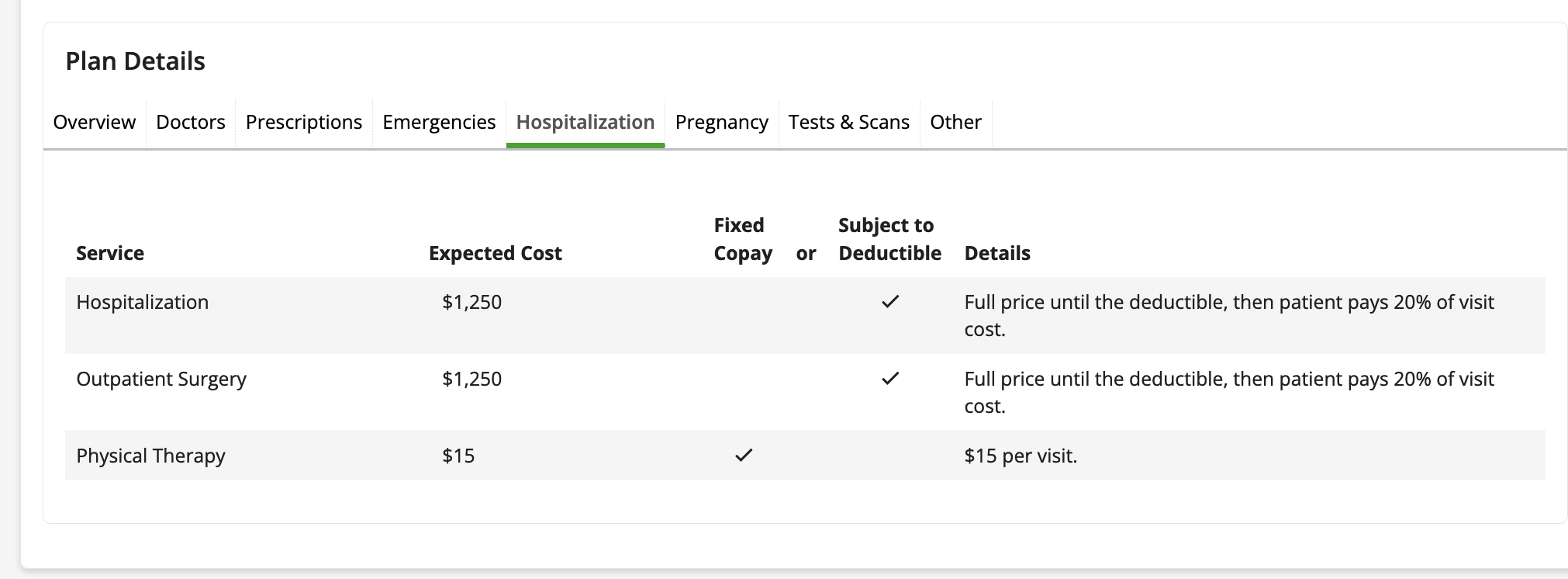
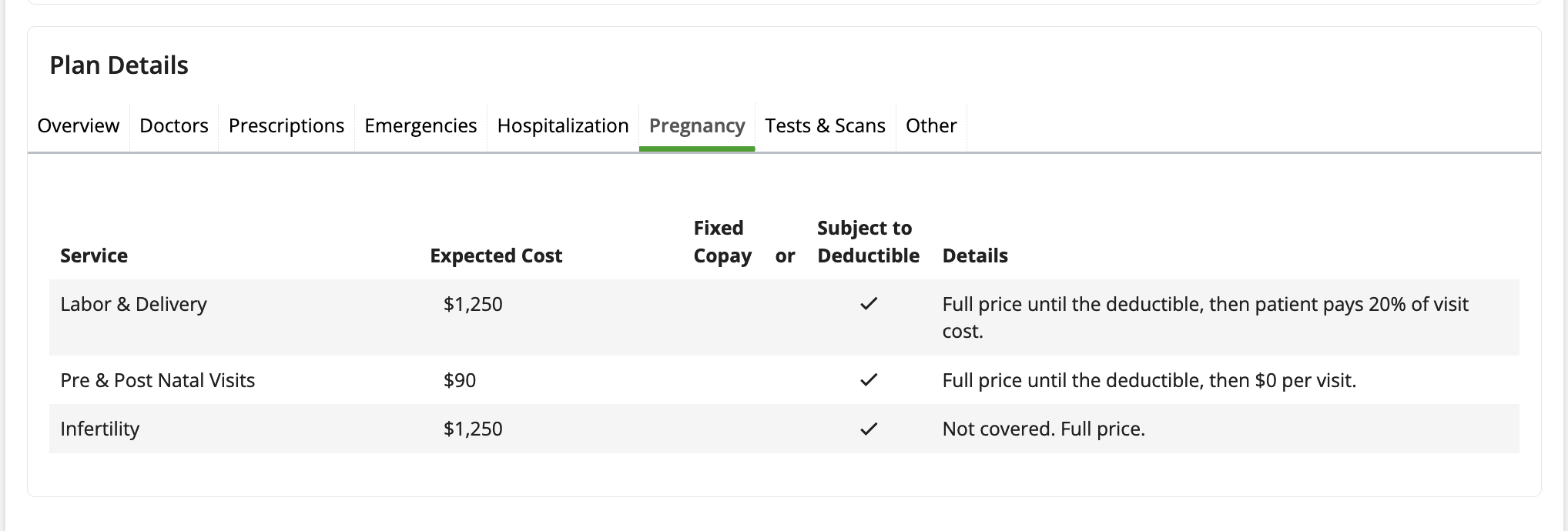
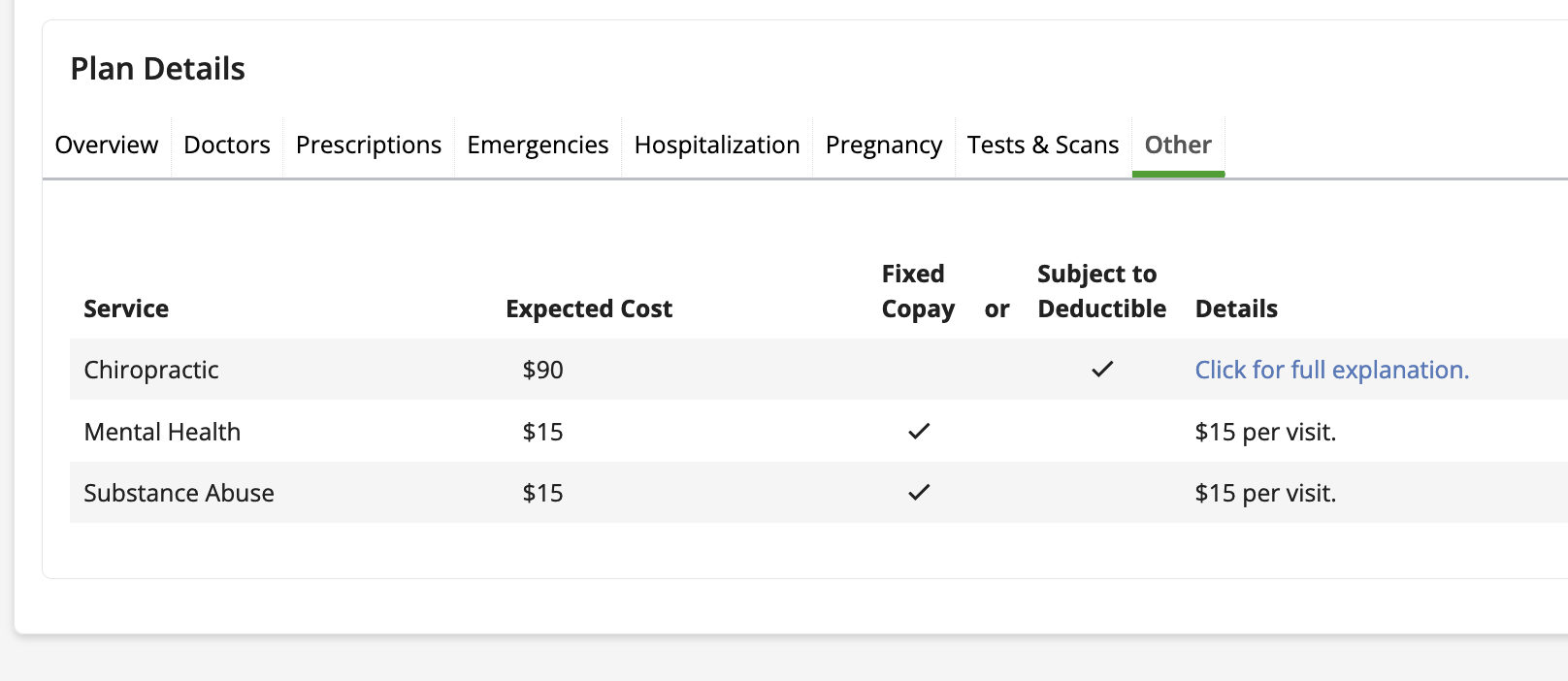
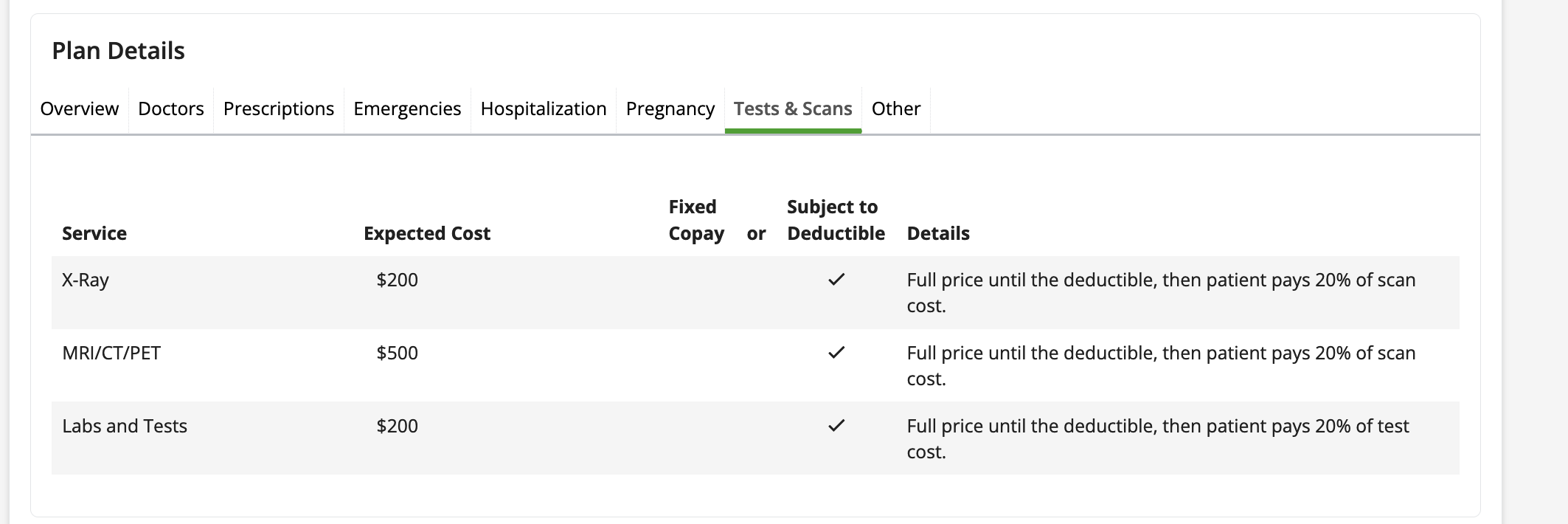
Employees under both full-time and part-time contracts are eligible for healthcare coverage. We currently offer a UnitedHealthcare CV45/K35Y package with 20% employee copay.
[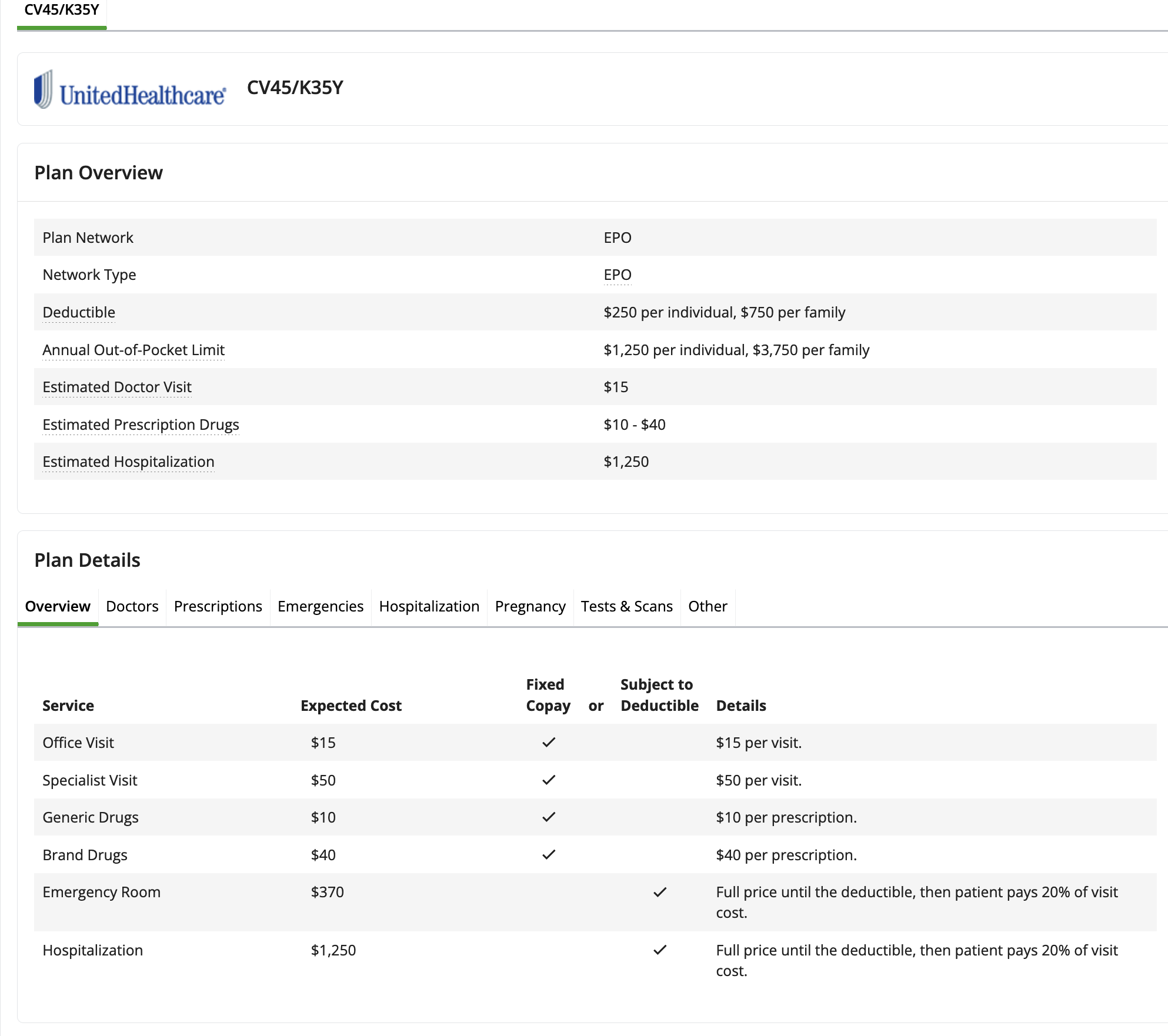](https://docs.punctumbooks.com/uploads/images/gallery/2023-09/yCytQhuRsYPu9NjX-screenshot-2023-09-27-at-08-56-51.png)
[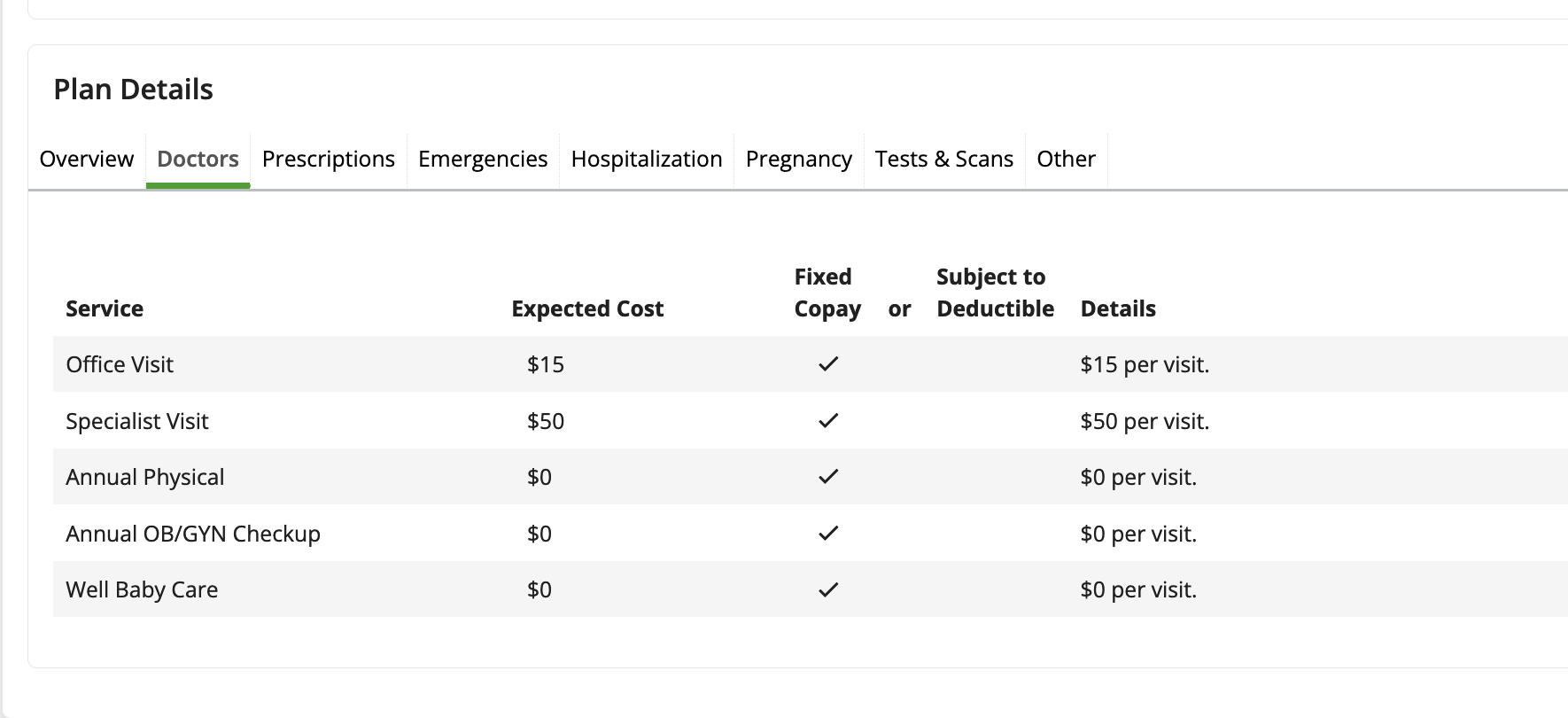](https://docs.punctumbooks.com/uploads/images/gallery/2023-09/eDvPfx6rC5OmgUZM-screenshot-2023-09-27-at-08-56-58.png)
[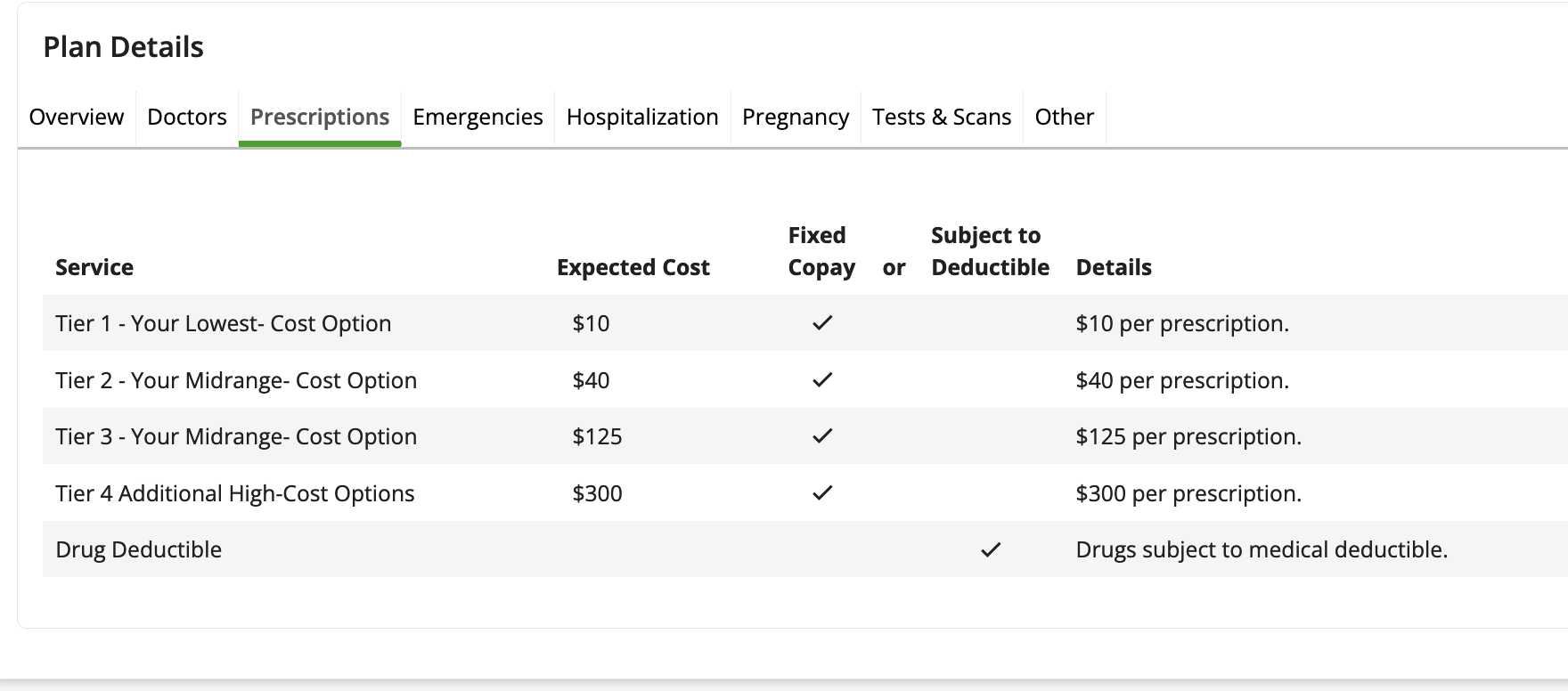](https://docs.punctumbooks.com/uploads/images/gallery/2023-09/iCMhQEProQlRQgU5-screenshot-2023-09-27-at-08-57-01.png)
[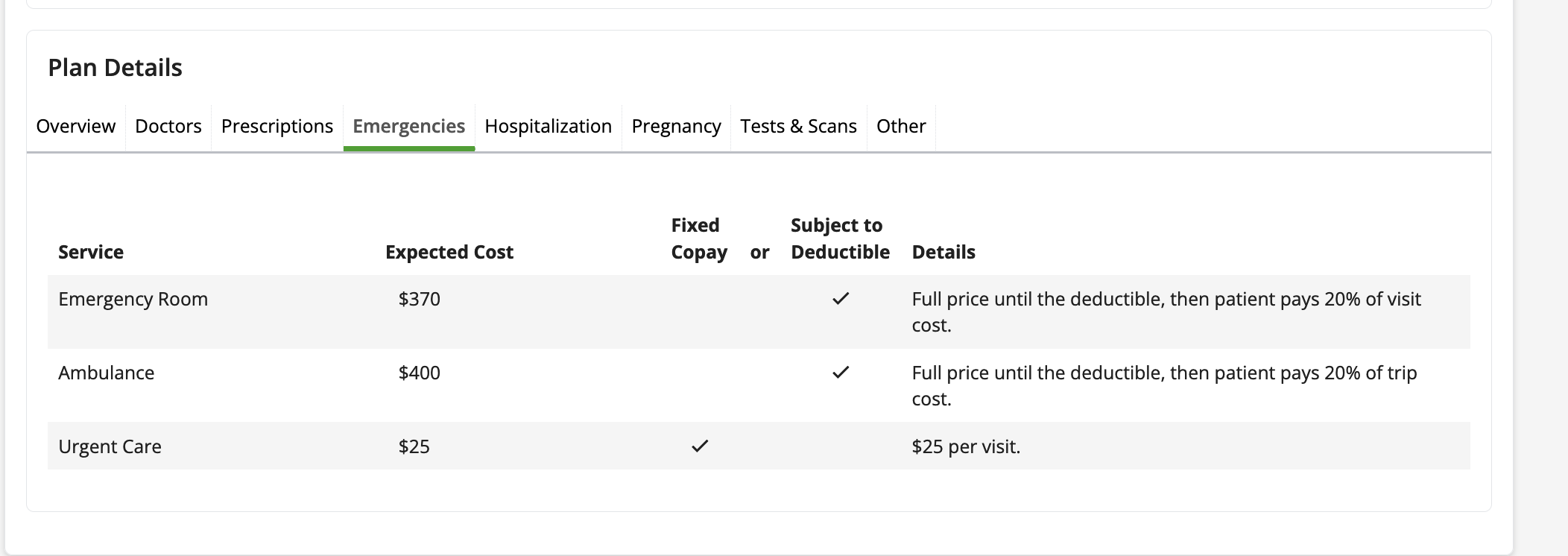](https://docs.punctumbooks.com/uploads/images/gallery/2023-09/KRpdqKE8eHSSsoQp-screenshot-2023-09-27-at-08-57-04.png)
[](https://docs.punctumbooks.com/uploads/images/gallery/2023-09/kA908wJiW65WPtIV-screenshot-2023-09-27-at-08-57-06.png)
[](https://docs.punctumbooks.com/uploads/images/gallery/2023-09/4kwV3Zj26UYsvpr1-screenshot-2023-09-27-at-08-57-10.png)
[](https://docs.punctumbooks.com/uploads/images/gallery/2023-09/Jr5osRtbMa98OxDf-screenshot-2023-09-27-at-08-57-17.png)
[](https://docs.punctumbooks.com/uploads/images/gallery/2023-09/Ej5eM1VSO0xsBpDi-screenshot-2023-09-27-at-08-57-14.png)
#### Pension
punctum books currently doesn't offer a pension plan. The possibilities for instituting this will be researched in 2024.
#### Remote Working
As punctum books has no central office locations, all its employees work from home or remotely. For each employee, an assessment will be made with regards to their hardware and software needs, as well as any subscriptions to online services and database credentials that may be necessary. These will be covered by punctum.
Employees are encouraged to be proactive in requesting any additional equipment that may make their work from home more efficient. Any hardware provided by punctum under this arrangement remains its property and should be returned upon termination of a contract.
Please keep receipts for all reimbursable expenses. You can submit them to your manager [*through our expense software*] within [*three months*] after the date of each expense. If your manager approves your expenses, you will receive your reimbursement within [*two*] pay periods [*by check*.]
Please keep receipts for all reimbursable expenses. You can submit them to your manager [*through our expense software*] within [*three months*] after the date of each expense. If your manager approves your expenses, you will receive your reimbursement within [*two*] pay periods [*by check*.]
Please keep receipts for all reimbursable expenses. You can submit them to your manager [*through our expense software*] within [*three months*] after the date of each expense. If your manager approves your expenses, you will receive your reimbursement within [*two*] pay periods [*by check*.]
Please keep receipts for all reimbursable expenses. You can submit them to your manager [*through our expense software*] within [*three months*] after the date of each expense. If your manager approves your expenses, you will receive your reimbursement within [*two*] pay periods [*by check*.]
Please keep receipts for all reimbursable expenses. You can submit them to your manager [*through our expense software*] within [*three months*] after the date of each expense. If your manager approves your expenses, you will receive your reimbursement within [*two*] pay periods [*by check*.]
Please keep receipts for all reimbursable expenses. You can submit them to your manager [*through our expense software*] within [*three months*] after the date of each expense. If your manager approves your expenses, you will receive your reimbursement within [*two*] pay periods [*by check*
Please keep receipts for all reimbursable expenses. You can submit them to your manager [*through our expense software*] within [*three months*] after the date of each expense. If your manager approves your expenses, you will receive your reimbursement within [*two*] pay periods [*by check*.]
Please keep receipts for all reimbursable expenses. You can submit them to your manager [*through our expense software*] within [*three months*] after the date of each expense. If your manager approves your expenses, you will receive your reimbursement within [*two*] pay periods [*by check*.
#### Professional development
punctum books is committed to the continued professional development of its staff. The Directors will discuss with individual staff members what their short- and medium-term professional goals are and how punctum books can help their realization. This may mean reduced work hours to go back to school or contributions to attend courses or conferences.
Please keep receipts for all reimbursable expenses. You can submit them to your manager [*through our expense software*] within [*three months*] after the date of each expense. If your manager approves your expenses, you will receive your reimbursement within [*two*] pay periods [*by check*.]
Please keep receipts for all reimbursable expenses. You can submit them to your manager [*through our expense software*] within [*three months*] after the date of each expense. If your manager approves your expenses, you will receive your reimbursement within [*two*] pay periods [*by check*.]
- \[*Business travel*\]
- \[*Relocation*\]
- \[*Education and training*\]
- \[*Upon approval, outings with business partners or colleagues*\]
# Confidentiality and Data Protection
### Personal Data
punctum books is the data controller of personal data of the following groups:
1. Staff
2. Authors, editors, and other contributors to book projects
3. Donors/Subscribers
4. Library supporters
5. Bookstores, vendors, and other commercial partners
All personal data stored in emails, Wordpress, Nextcloud, and InvoiceNinja are stored on encrypted servers managed by Cloud68. None of these data may be disclosed to the public without explicit authorization from the co-directors.
#### Staff records
Staff records for the purpose of payroll are held within Quickbooks. Banking information is only accessible to the employees themselves via their own login. Payroll management is only accessible to the co-directors. Staff records are stored on NextCloud and Bookstack and only accessible to the co-directors.
#### Contributor records
Personal information of authors, editors, and other contributors to book projects is provided by them throughout the book production process. At the point of manuscript submission, contributors provide their name, biography, ORCiD, and social media handles for outreach and metadata purposes.
When the book is published, contributors provide their address information for the purpose of receiving author copies. This address information is recorded within KDP, from where it is automatically deleted after some time.
When contributors order extra author copies, their address information is recorded in InvoiceNinja for the purpose of invoice generation.
#### Subscriber records
When new donors or subscribers decide to support punctum books, their personal and credit card are managed by Stripe, but the co-directors have access to a subset of these data via the Stripe dashboard.
There are legacy data in the Wordpress website of subscribers that supported punctum books through two different Wordpress plugins. As these subscriber resubscribe or cancel, there will be increasingly less personal data of from subscribers accessible through the Wordpress backend.
#### Library Supporter records
Contact information of Library Supporters is kept in Trello and several Google Sheets. For invoicing purposes we also store these data in InvoiceNinja.
#### Vendor records
Bookstores, vendors, and other commercial partners of punctum may provide address information for the purposes of shipping books and invoicing. These data are stored in KDP and InvoiceNinja.
### Financial Data
punctum books is a public benefit corporation and as such publishes a yearly [activity and financial report](https://punctumbooks.pubpub.org/punctum-financials).
Bank account information, tax identifiers, and login info for online payment systems Stripe and Paypal are held on Bookstack (only accessible to codirectors) as well as an encrypted password vault. Tax and other financial documents are held in the Punctum Accounting folder on Nextcloud, only accessible to co-directors and the accountant. Accounting and tax management is done through Quickbooks, to which the CFO and the accountant have access.
The CFO keeps a spreadsheed in Google Docs with quarterly and annual financial forecasts.
Except those published in the annual report, none of these data may be disclosed to the public without explicit authorization from the co-directors.
### Device Security
All devices that you use for punctum business or to access punctum platforms or accounts should be secure.
- Keep all devices password-protected and use a password manager such as [KeePassX](https://www.keepassx.org/) to generate strong passwords;
- Do not leave devices unattended;
- Install security updates for browsers and other systems as soon as updates are available.
Install security and software updates as soon as they are available;
- Log in to company platforms and account only via safe (wifi) networks. Use a VPN when on public wifi, such as [ProtonVPN](https://protonvpn.com/).
### Emergency Protocols
All essential punctum passwords and logins are stored in an encrypted [KeePassX](https://www.keepassx.org/) password vault. This is the file punctum4.kdbx. The password to this file is stored in a red box in the CFO's bedroom, to which his partner has access. True story!
# Employee Onboarding
### Accounts
#### Website
For the website a photo, short bio, and key interest fields are needed. The info is added to the [Organization](https://punctumbooks.com/about/organization/) page on the website.
#### Email
A new account will be requested \[first name\]@punctumbooks.com via Cloud68. This needs to be done first so all account invites can go there.
#### Mattermost
A new account can be set up by the new employee via the [signup page](https://chat.punctumbooks.com/signup_user_complete).
#### Trello
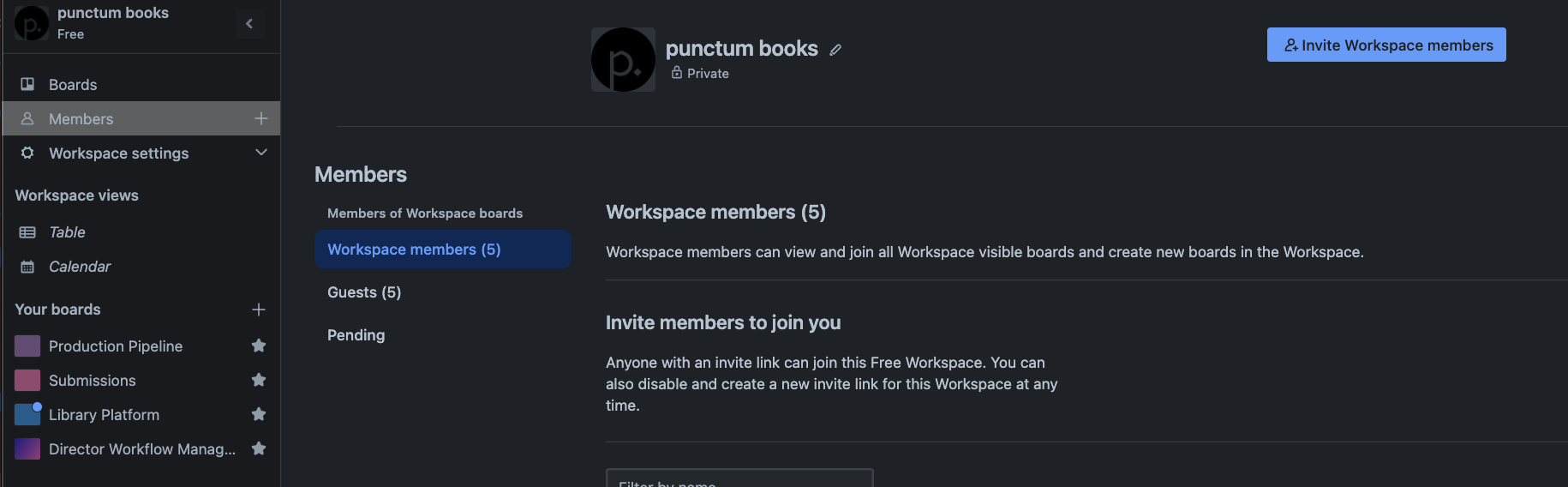
If the new employee is involved in production, they get access to one or more Trello boards. Users are added by selecting Members in the lefthand menu in the app and then click "Invite Workspace members."
[](https://docs.punctumbooks.com/uploads/images/gallery/2023-09/ZqpxO7GsgZHTLdMc-screenshot-2023-09-23-at-07-05-15.png)
#### Nextcloud
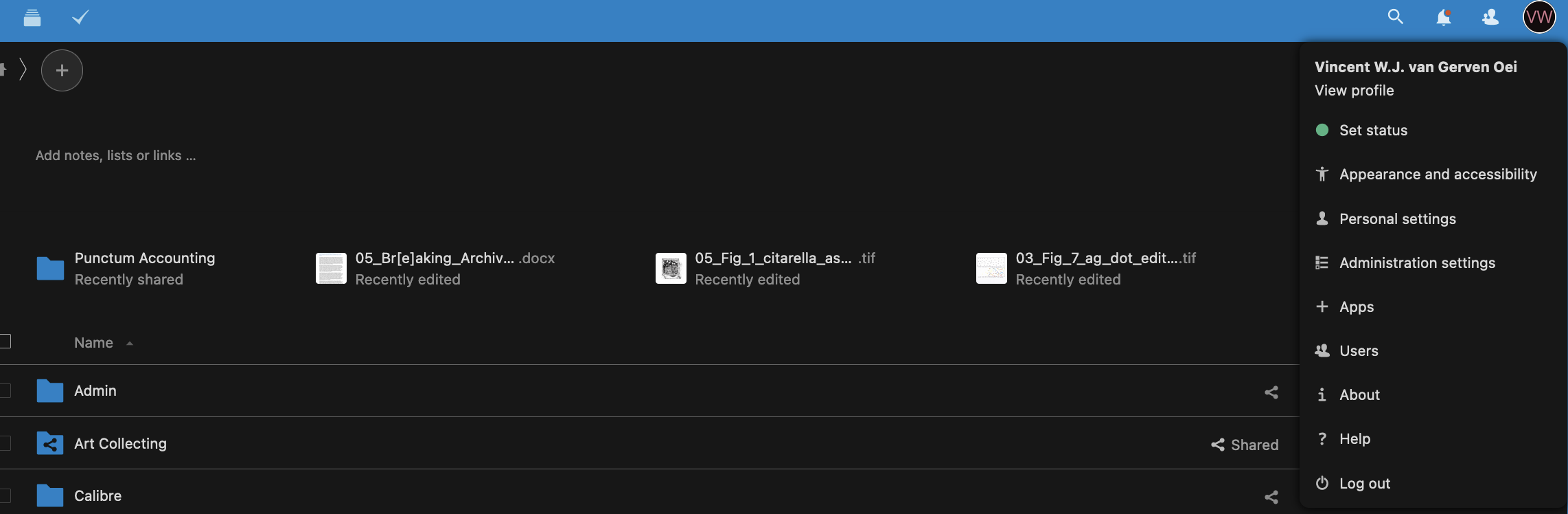
New employees are added in Nextcloud via the Users menu item. They are added to the group "punctum" and get unlimited storage space.
[](https://docs.punctumbooks.com/uploads/images/gallery/2023-09/CXN1SkyiMJ32SiNV-screenshot-2023-09-23-at-07-10-15.png)
### Payroll and Insurance
New employees will be to the Quickbooks accounting system on Payroll.
# Employee Resignation and Termination
### Resignation
You resign when you voluntarily inform the Directors that you will stop working for punctum books. We also consider you resigned if you stop responding to emails, Mattermost messages, or other attempts to get in touch for a week.
You are not legally obliged to give us advance notice before resigning. But we appreciate it if you give us a month's notice, if possible.
We accept verbal resignations, but we prefer that you submit a written and signed notice of resignation. We will reply with an acceptance of resignation letter within two days. Whether you want to annouce your resignation to the other employees is up to you.
### Termination
We are a small company where everyone is working closely together. We are committed to being accepting of different working styles and rhythms, but at the end of the day we need to publish books. If books no longer are being published, we have a problem and that problem demands to be addressed.
We do not have a strict disciplinary system in place like other companies, but Directors will indicate when the work delivered is a below what we expect from our employees. Every employee is responsible for their own targets, and the most important thing is that there is clarity on expectations on all sides. We need to be able to depend on each other, and this is what the weekly staff meetings are there for to coordinate.
When the Directors feel that an employee is no longer functioning will within the company, there will be a private, informal conversation in which these concerns are explained and solutions are developed communally. If these solutions fail to materialize or provide the desired results, additional sessions may be held to address the dysfunction, but at a certain point, a point that is to be determined by the Directors, there are no viable alternatives except termination of contract.
Punctum directors will provide a written notice of termination of contract in general one month in advance, but depending on the situation termination may also be immediate. Employees have the right to one month of severance pay after working for longer than 12 months at punctum.
Whether an employee either resigns or has their contract terminated, the following steps are undertaken:
- Any devices purchased by punctum books for the employee will need to be returned or to be acquired for a pro-rated price;
- The employee's email address will be canceled by the date of severance and rerouted to the general email address. An out of office message will be installed indicating the date of severance and alternative email addresses;
- Cancellation of any debit cards issued;
- The employee's access to Nextcloud folders and Mattermost channels, punctum social media, and other relevant accounts will be terminated by the date of severance. General Nextcloud access will be granted if the employee needs time to move personal files.
# Standard Production Deadlines
# Review
- Returning manuscript after peer review: in discussion with author/editor
- Returning manuscript after manuscript review: in discussion with author/editor
# Copyediting
- Returning first edits (monographs): 2 weeks
- Returning first edits (edited volumes): 3 weeks
- Small queries after the edited ms has been returned: As soon as possible (with friendly verbiage).
# Proofing
- Returning proof corrections (monographs): 1 week
- Returning proof corrections (edited volumes): 2 weeks
- Small queries following proofing: As soon as possible (with friendly verbiage).
# Subject Classification Policy
### Custom Categories
These are the custom categories used by punctum. Ideally choose 2, maximum 3 categories. The point it not to be exhaustive (for this we have the other subject schemes). It is to gather together titles in allusive groupings.
- Anthropocene: the "end(s)" of humanity, climate emergency, human impact on the planet
- Art+Aesthetics: books by/about artists
- Autotheory: biographical approaches to the theoretical and theoretical approaches to biography
- Biosphere: nature/ecology studies
- Built Environments: architecture
- Capital+Lucre: capitalism, economic theory, expenditure, surplus
- Cultural Studies+Critical Theory: cultural studies and critical theory
- Fabulations: fiction, poetry
- History: history
- Humanities+University: university studies, humanities
- Languages+Translations: linguistics, translations, language philosophy
- Literary Studies: literary studies
- Manifesto!: manifestos, pamphlets, calls to action
- Media+Technology: media studies, STS
- Moving Image: film studies
- Neurodiverse+Crip: neurodiverse and crip studies/authors
- New Left Thought: political theory
- Pedagogies: pedagogy
- Philosophy: philosophy
- Posthumanism: the post-, other-, and more-than-human. Books about the *impact* of humankind on the planet should go under Anthropocene.
- Premodern: classical, medieval studies
- Sex: sexuality, pornography
- Sound+Noise: sound studies, music, noise
- Thought Experiments: experimental writing, cross-genre publications, aphoristic/fragmentary writing
- TransQueer: LGBTQIA+ studies, authors
Distinguish between **Cultural Studies+Critical Theory** and **Literary Studies**
Distinguish between **Fabulations** and **Thought Experiments**
### Thema
[Thema 1.6](https://ns.editeur.org/thema/en) is the currently most detailed open subject classification schema. Proper Thema classification is essential to book discoverability.
#### Thema's Six Golden Rules
- Ensure the first subject category is the primary or main subject of the book (with ONIX, use <MainSubject/>)
- Select further categories that together best describe the subject and scope of the book: use broader codes for wide-ranging approaches; use more precise codes for works that focus on specific topics
- Don’t assign both a detailed category *and* a broader ancestor of that category (*eg* both FJH and FJ)
- In general, top level codes (*eg* F or V) are not suitable for use – choose more detailed codes *beginning with* F or V
- Assign as many categories as are required to describe the overall content of the work (within reason)
- It’s very unusual to require more than three or four subject categories (codes beginning A–Y), and often, just one or two categories are enough
- Observe any scope notes and instructions (see the ✽ symbols above)
- Add qualifiers (codes beginning 1–6) whenever appropriate, to refine the meaning of the subject categories
- Qualifiers cannot be used alone, without at least one subject category
- Always consider the context of the categories within the hierarchy
#### Furthermore
- Select codes based on what the publication *is about*
- Use one or multiple codes from category headings A–Y
- If the publication concerns a specific *place*, choose a qualifier from category 1
- If the publication concerns a language other than English, choose a qualifier from category 2 **(not to be used for the language the title *is in*)**
- If the publication concerns a specific time period, choose a qualifier from category 3
- If the publication concerns a specific interest group, choose a qualifier from category 5
- 5P categories for LGBTQIA+, intersex, trans, disabled, indigenous, Black, etc.
- 5T for literature of a specific country (used for translations)
- If the publication concerns a specific artistic, literary, or musical style, choose a qualifier from category 6
- Limit Thema categories to max. 6 items.
### BISAC
[BISAC](https://www.bisg.org/complete-bisac-subject-headings-list) is a very rough ad outdated subject classification scheme that inexplicably is still widely used in the book industry. KDP and Asterism Books have this as their standard classification system.
### Keywords
Keywords are provided by the author as part of the manuscript submission process, but additional ones are added based on a review of the content, book summary, and the introduction/preface.
### LCC
Library of Congress classification (LCC) is assigned by the LOC after they have received the print copy from us upon publication and have processed it into their catalog. Current catalog [here](https://catalog.loc.gov/vwebv/search?searchArg1=punctum+books&argType1=all&searchCode1=KPUB&searchType=2&combine2=and&searchArg2=&argType2=all&searchCode2=GKEY&combine3=and&searchArg3=&argType3=all&searchCode3=GKEY&year=1524-2024&fromYear=&toYear=&location=all&place=all&type=all&language=all&recCount=25).
Since there is no way to automate ingest of this information into Thoth as of yet, LCC is not recorded in the Thoth record.
### Document Control
| **Document ID** | POL-001 |
| **Document Owner** | Vincent |
| **Version** | 1.0 |
| **Last Date of Change** | November 10, 2025 |
| **Next Review Due Date** |
|
| **Version & Change Tracking** |
|
# Style Policy
punctum style follows the [*Chicago Manual of Style* v. 17](https://www.chicagomanualofstyle.org/book/ed17/frontmatter/toc.html). The policy outlined here includes authors' common mistakes according to CMoS use, reminders for uncommon CMoS use, and punctum-specific amendments to the CMoS.
#### Punctuation (**CMoS 6.0**)
##### Punctuation relative to surrounding text (**CMoS 6.2**)
- In text, commas and periods do not follow an exclamation or question mark.
- E.g., "What's the rush**?" s**he wondered.
- In bibliography/reference, for source titles, commas and periods do not follow an exclamation or question mark.
- E.g., Braidotti, Rosi, and Rick Dolphijn. "Deleuze's Philosophy and the Art of Life, or, What Does Pussy Riot Know**?" I**n *This Deleuzian Century: Art, Activism, Life*, edited by Rosi Braidotti and Rick Dolphijn, 13–36. Leiden: Brill, 2014.
- In footnotes, for source titles, commas and periods do follow an exclamation and question mark.
- E.g., Rosi Braidotti and Rick Dolphijn, "Deleuze's Philosophy and the Art of Life, or, What Does Pussy Riot Know**?," i**n *This Deleuzian Century: Art, Activism, Life*, edited by Rosi Braidotti and Rick Dolphijn (Leiden: Brill, 2014), 13.
- For block quotes: in-text author-date citations follow the text and the text's final punctuation. No punctuation follows the citation. Note too that block quotes are absent surrounding quotation marks. Any secondary quoted material within the block quote is in double quotation marks.
- E.g., *Block quote***. (**Lastname 1990, 90**)**
- Ellipses and punctuation: in order to ensure that the quoted material is consistent with the author's syntax, the author should include the punctuation that either precedes or follows the omitted quoted material.
- E.g., "This force of blood **\[...\]** exists nowhere but in tragedies and romances **\[...\].** To imagine any such mysterious affection would be ridiculous." *or*, "from within a century-long history of struggle against compulsory heterosexuality**, \[...\]**"
##### Slashes
Never between words. Not and/or; so forth.
Between line in poetry and lyrics: space / space; between stanzas: space // space
##### Commas
***Oxford comma/serial comma is god***. We have all sworn a blood oath and are prepared to die on this hill. (Except when original quotations do not contain them.)
- Commas with "etc." and "et al." (**CMoS 6.20**). A comma should precede "etc." but not "et al." Punctum style insists these are not italicized.
- Exception to comma before et al. In bibliographic entries, when et al. appears with the editor, author, creator, etc., a comma will appear. NB: et al. should rarely, if ever, be included in the bibliography, and all names should be listed. There are two exceptions: first, if there are more than seven co-authors and second, if there are creators, authors, and illustrators, a practice that occurs most regularly in comic books.
- E.g., Byrne, John, et al. *Superman: The Man of Steel*. New York: DC Comics, 1986.
- NB: "etc." is used for objects and things; "et al." is used only for people.
- NB: "etc." is used for finite objects and things in a list (e.g., "my kitchen has a sink, refrigerator, etc."). "And so forth" or "and so on" are used for nonfinite lists (e.g., "sovereigns, emperors, popes, Orthodox patriarchs, and so forth," signaling that the list can go on). "And the like" serves a similar purpose when the items in the list are specifically related (e.g., "semicolons with 'however,' 'therefore,' 'indeed,' and the like," signaling that the terms that follow are of a related class).
##### Semicolons and colons (**CMoS 6.56**)
No one knows the rules for colons and semicolons, so it is best that editors limit their use as much as possible. These are the few instances where they are consistently used correctly.
- Traditionally, semicolons sometimes precede conjunctive adverbs, such as, "however," "hence," "indeed," "accordingly," "besides," and "therefore." A comma will follow that adverb. However, a period it is punctum style to use a period and a period is always more appropriate.
- XXXX VINCENT!!
- *punctum style*: to avoid excessive brackets on the initial letter of a quotation (e.g., the past to guide the living in the present**,** “**\[t\]**he Master said, ..."), the editor should change the punctuation that precedes the quotation if the quotation that follows is not consistent with the syntax of the sentence within which it is embedded. One exception to this rule, which is that the capitalization must be consistent in the syntax of the sentence, usually following "that," "as," "like," "because," or conjunctions, but not limited to these.
- e.g., the past to guide the living in the present**,** “**t**he Master said, ..."
- e.g., the past to guide the living in the present**:** “**T**he Master said, ..."
- e.g., however, the past to guide the living in the present, **that** “**\[t\]**he Master said, ..."
- e.g., however, the past to guide the living in the present, **as** “**\[t\]**he Master said, ..."
- Colons can introduce a list if this list is not consistent with the preceding sentence's grammar.
- Correct: "I bought eggs, cheese, and fish." "I loved what I bought today: eggs, cheese, and fish."
- Incorrect: "I bought: eggs, cheese, and fish."
See this example, where I'll knock out a bunch of rules:
> This is what I propose to develop in this chapter by looking at the three components of that she calls the family paradigm: 1) Family is a privatized system of household-based social reproduction; 2) the couple is a cultural form; and 3) biogenetic-centered kinship is privileged.
First, the list is introduced with a colon because what follows is not syntactically consistent with the introducing clause. (Compare to "I went to the store to buy eggs, milk, and pizza." This list is consistent with the syntax of the sentence.) Second, semicolons separate complete sentences when in a list. Third, the F in "Family" is capitalized because it is a complete sentence that follows with other complete sentences in a list.
##### Hyphens and Dashes (**CMoS 6.75**)
- Use en dashes for number ranges, either date, page, and so forth. For example, (Earth: punctum books, 2016), 14–45. Or, *Visions of Excess: Selected Writings, 1927–1939*, edited by Allan Stoekl.
- *punctum style* allows for either the en dash ( – ) \[Mac: option + hyphen\] or the em dash (—) \[Mac: shift + option + hyphen\]. Their use must be internally consistent throughout the manuscript, even across essays in an edited collection.
- En or em dashes should rarely be used and should not take on the role of other punctuation when there are regular commas and periods in the world. There are a few common instances to use en or em dashes appropriately:
- En and em dashes are used to signal interjecting thoughts.
- E.g., "Auracticity is a sort of indefinite emotional response, akin to the sublime but prolonged—ignorance’s mediation."
- E.g., "So I understand the bluster of wind and rain not as representation per se but means to hint toward truer—obscured, alas!—subjects worth attention."
- En and em dashes are most commonly used in a "that is" or "namely" phrase. If "that is" or "namely" is used, it should not be used in conjunction with a dash because that would be redundant.
- E.g., "Jazz is a mechanical—akinetic, or disembodied—language that nevertheless strives in nineteenth-century style for its tonal resolution. Classical is the sated lion, capably fanged—kinetic, or corporeal—but harmless just the same."
##### Parentheses
- *punctum style*: for parentheses use, say it or don’t. Parentheses should only be used when it’s grammatically necessary. The reader should be able to draw their own emphasis and significance from the writing. When a comma or en or em dash will do, the author should consider opting for those. Parentheses should be used only when the sentence within the parentheses is otherwise ungrammatical with the surrounding text. Parentheses should very rarely be used, outside of translation; for example, "livraison rapide" ("fast delivery").
##### Quotation marks
- Scare quotes (**CMoS 7.57**): “Quotation marks are often used to alert readers that a term is used in a nonstandard (or slang), ironic, or other special sense. Such scare quotes imply 'this is not my term' or 'this is not how the term is usually applied.' Like any such device, scare quotes lose their force \[…\] if overused.” Further, **CMoS 7.60:** "Quotation marks are rarely needed for common expressions of figures of speech (including slang). They should normally be reserved for phrases borrowed verbatim from another context or terms used ironically."
- *punctum style*: like italics, scare quotes are so rarely necessary and should not be used to manipulate readers. The reader should be able to draw their own emphasis and significance from the authors' writing.
- Quotation marks should not be used for emphasis.
- When altering initial capitalization at the beginning of quoted text, use brackets.
- E.g., As Joshi has written, “\[t\]he true horror…”
##### Numbers
- Ages are not spelled out unless they begin a sentence. Numbers in ages should be hyphenated when used as an adjective.
- E.g., They were 32 years old. (No hyphens.) They turned 33. They were a 33-year-old accountant. (Hyphens.) Thirty-three was the age they got their first dog.
- In percentages, use the number and spell out percent unless it begins a sentence.
- E.g., There was a 4 percent increase.
- Number ranges should be punctuated with an en dash, not a hyphen (e.g., 94–95). Number ranges should begin omitting the first number of the second number in a range in ranges starting after 99 (e.g., 8–14, 103–77, 125–55, 136–37, 187–204, 1034–99, and so on). An exception to this rule is when the number preceding the final number is a "0" (e.g., 103–9). Year ranges are done the same.
- Numbers zero through ninety-nine should be spelled out and hyphenated when necessary.
- Centuries should be spelled out (e.g., nineteenth century, twentieth-century art, mid-twentieth-century art)
- The suffix (st, nd, rd, th) on nominal numbers should not be in superscript formatting.
##### Dates
- 1950s, '60s, and '70s \[reverse apostrophe\]
- CE is implied unless it is used in proximity to a date BCE. BCE is always marked unless all dates in the text are BCE. There is always a space between the number and BCE or CE, BCE and CE always appear after the number, and there are never periods separating the numbers (e.g., 354 BCE–22 CE; 354–12 BCE; 258–508; 1956–1990).
##### Other Specific Usages
- UK, US(A), and DC are written without periods.
- versus, not vs.
- Degrees: **M**aster**'**s degree, uppercase with an apostrophe; PhD, no periods
- "and/or": punctum is against the usage of "and/or." First off, English "or" can be used inclusively as in "milk or sugar"; second, "and/or" just interrupts the reading.
- Movements: avant-garde, hyphenated
- Political movements not capitalized unless based on a personal name, e.g,. communism, fascism, nazism; but Marxism, Stalinism, Maoism, Hitlerism
- All religions should be lowercase (e.g., catholicism, methodism, Greek orthodox, so forth). But Christianity, Lutheranism, Buddhism (depending on your definitions) are based off a guy and carry the proper noun of his name or post. However, the names of the religions I/islam, J/judaism, H/hinduism, S/sihkism are not named after people. Therefore, it's the author's choice for their use, but use should be consistent. Nevertheless, these are also acceptable:
- buddhism, buddhist; christianity, christian; hinduism, hindu; judaism, jew; haredi judaism, hasidism, hasidic jew; orthodox jew; baptist, anabaptist, puritan, so forth.
####
#### Style
##### Italics
- **CMoS 7:49**, “Italics as such are used for emphasis, key terms or terms in another language, words used as words, titles of works, and so on.”
- The author should not use italics suggestively that might manipulate a reader’s reading on a subject (e.g., “this would *seem* to follow Stahl’s emphasis on function”).
- Italics are used for words in a language other than English, unless that phrase is in Merriam-Websters Dictionary.
- Italics should be used when the author is coining a term at that term's first occurrence, using an unfamiliar phrase in another language, in book titles, and other cases where the italicized word or term followed **CMoS 7:50**, “Use italics for emphasis only as an occasional adjunct to efficient sentence structure. Overused, italics quickly lose their force. Seldom should as much as a sentence be italicized for emphasis, and never a whole passage.” See also
- Italics: The author should only use italics unless they are:
- emphasizing a very specific something in the main text, only in the first occurence (e.g., a concept they’re coining),
- emphasizing a word or a phrase in quoted material that they will immediately discuss,
- using a word in a language other than English that is not in the Merriam-Webster Dictionary (In this case, the English translation should appear in parentheses after the italicized original word.
- *punctum style*: the use of italics is so rarely necessary. Italics should not be used to manipulate readers; the reader should be able to draw their own emphasis and significance from the writing.
##### Capitalization
- *punctum style*: as mentioned above, to avoid excessive brackets on the initial letter of a quotation (e.g., the past to guide the living in the present**,** “**\[t\]**he Master said, ..."), the editor should change the punctuation that precedes the quotation if the quotation that follows is not consistent with the syntax of the sentence within which it is embedded. One exception to this rule, which is that the capitalization must be consistent in the syntax of the sentence, usually following "that," "as," "like," "because," or conjunctions, but not limited to these.
- e.g., the past to guide the living in the present**,** “**t**he Master said, ..."
- e.g., the past to guide the living in the present**:** “**T**he Master said, ..."
- e.g., however, the past to guide the living in the present, **that** “**\[t\]**he Master said, ..."
- e.g., however, the past to guide the living in the present, **as** “**\[t\]**he Master said, ..."
##### Abbreviations
- "i.e." and "e.g." are abbreviated only within parentheses. Outside of parentheses, they are spelled out as “that is” and “for example.”
- *punctum style*: "etc." is appropriate in all cases, though one might prefer "and so on," or something of the like outside of parentheses.
##### Author Information In Text
- - On the first occurrence, the author should include the first and last name of a cited author. Afterwards, the author may refer to the cited author by the last name. This goes for famous authors and philosophers as well. (E.g., Immanuel Kant, Kant; Georges Bataille, Bataille. Jennifer Mench, Mench)
- For names that contain initials, do not put a space in between the letters (e.g., H.P. Lovecraft).
##### US English
- English US is preferred unless the author is wholly and consistently in UK or AUS English including both puctuation, diction, and grammar, which is very rarely if ever the case.
##### Limit Excessive Punctuation
The following is a shortcut statement to authors that use excessive punctuation, especially when the punctuation above is so overused, sentences lose their force or effect and, most significantly, cloud the author's meaning.
> punctum style discourages excessive use of parentheses, colon, semicolon, en-/em-dash, and scare quotes use. Their use should be grammatical and sparse. Parentheses are used when the sentence within the parentheses is otherwise ungrammatical with the surrounding text and when the sentence cannot be revised otherwise. Colons are used when introducing a list, and this list is not consistent with the preceding sentence's grammar. Semicolons may precede conjunctive adverbs, such as, "however," "hence," "indeed," "accordingly," "besides," and "therefore." Often, then, a comma will follow that adverb. En or em dashes should rarely be used and should not take on the role of other punctuation when a comma or period would be suitable. Further, en and em dashes are used to signal interjecting thoughts, and are most commonly used in a "that is" or "namely" phrase. If "that is" or "namely" is used, it should not be used in conjunction with a dash because that would be redundant. Scare quotes are used to alert readers that a term is used in a nonstandard (or slang), ironic, or other special sense. While this punctuation is acceptable in moderation, these devices lose their force if overused.
#### Photo Credits
Fig. XX. \_\_\_\_\_. Credit \_\_\_\_. In text mention of a figure (fig. XX).
Table XX. \_\_\_\_. In-text of a table (table XX) of (t. XX).
Plate XX. \_\_\_. In-text mention of a plate (pl. XX).
### Document Control
| **Document ID** | POL-002 |
| **Document Owner** | Vincent |
| **Version** | 1.0 |
| **Last Date of Change** | November 10, 2025 |
| **Next Review Due Date** |
|
| **Version & Change Tracking** |
|
# Reference Policy
punctum style follows the [*Chicago Manual of Style* v. 17](https://www.chicagomanualofstyle.org/book/ed17/frontmatter/toc.html). The policy outlined here includes specific aspects of reference organization as well as exception to CMoS
### Bibliography
#### Titles
- For bibliography and footnotes regarding English-language sources, punctum style requires title capitalization, regardless of the original source. For example, it is appropriate to change sentence capitalization of a *Guardian* article to US English title capitalization.
- All caps (including prepositions as part of an idiom, e.g., Pulled Off). Lowercase conjunctions, prepositions, and articles (when not the first word). For hyphenated terms, if both words on either side of the hyphen are their own word (e.g., One-Way Street), then both words are capitalized. If the first word is a prefix or cannot otherwise stand on its own (e.g., Anti-) then the first letter of the first word is capitalized, and the second word after the hyphen is lowercase (e.g., Anti-woke). For titles, only lowercase conjunctions (and, or, yet – not "yet" when used as an adverb, e.g., "not yet" ), articles (a, an, the), and prepositions (in, on, at, by for, and so forth – keep prepositions capitalized if part of an idiom, e.g., *Growing Up in Appalachia*). Note: capitalize subordinating conjunctions (although, because, so – but not "so" when used as an adverb, e.g., "not so much" – and so forth).
- A majuscule letter will always follow a colon in titles in English and languages other than English.
- French language use in titles. Capitalize first word in the title and nothing else with the exception of proper nouns. Note: the article is capitalized and not the following text.
- e.g., *L'amour puni*; *Les fleurs du mal*; *Ubu roi*
- punctum style requires urls on online articles that are paywalled *and* have limited free monthly views; e.g., *The Guardian*, *The New York Times*, *The Washington Post*, so forth. Paywalled sites, e.g., *The Economist*, do not allow any free monthly views, so the url is not included. I'll amend the language in the style guide to reflect this more clearly.
- If a The appears in the masthead of a magazine or newspaper site, then the "The" is included.
- e.g., *The New York Times*, *The Washington Post*
#### Editors and Translators
- When there is an editor or series of editors and a translator or a series of translators, the editors are named first (e.g., Author, "Chapter." In *Title of Book***,** edited by Editor**.** Translated by Firstname Lastname. ...).
#### Publishers
- punctum books should always be referenced fully as **punctum books**.
#### Publication Dates
- Only the publication date for the sourced referenced should be included in the bibliography and the footnotes. If the author includes, in brackets (e.g., \[1978\] 2012), then the copyeditor should remove the original publication date. Authors are never consistent in including both dates, and there is no easy way to ensure they are.
#### Collation Order
- Titles: ignore quotation marks; numbers go before letters; in alphabetization, white spaces don't count (e.g., "At Times" comes before "A War").
- Author names: collated by last name, but respect the following language exceptions:
- German: **Ewald von Dingen**
- Collated as **\[D\]ingen, Ewald von**
- In-text reference as **Dingen**
- Dutch: Ewald van Dingen; Iris van der Tuin
- Collated as **van \[D\]ingen, Ewald**; **van der \[T\]uin, Iris**
- In-text reference as **Van Dingen**; **Van der Tuin**
- French: **Charles de Chambéry**; but exception for well-known names in English like **Charles de la Fontaine**
- Collated as **\[C\]hambéry, Charles de**; **\[d\]e la Fontaine, Charles**
- In-text reference as **Chambéry**; **De la Fontaine**
#### URLs
- Always include DOI in the bibliography, not the footnotes. If the DOI is not offered by the author, then search for the article or, if you cannot find the article, then ask the author to supply it. This is to ensure that the article is easily found by readers, even if the author originally read this in hardcopy form, which is doubtful anyway.
- Use DOI, JSTOR, Project MUSE, or other website URLs, but do not cite proprietary links hidden behind paywalls (e.g., *the Wall Street Journal*, *New York Times*).
- The DOI can be cited as a webpage (e.g., http://doi.org/10.1215...) or as a DOI: number (e.g., DOI: 10.1215...). Ensure that the author is internally consistent and uses only one form.
- Archived sources, especially WebArchive:
- E.g., Bolton, Olivia. "Meet the 'Real-Life Superheroes', Phoenix Jones and Purple Reign." *The Telegraph*, July 10, 2013. Archived at https://web.archive.org/ \[...\].
#### Volumes
- Dustan, Guillaume. *Novels*. **Vol. 1 of** *The Works of Guillaume Dustan*. Translated by Daniel Maroun. Los Angeles: Semiotext(e), 2021.
- Foucault, Michel. “Sex, Power, and the Politics of Identity.” In *Ethics: Subjectivity and Truth*, edited by Paul Rabinow. Translated by Robert J. Hurley, 163–73. **Vol. 1 of** *Essential Works of Foucault 1954–1984*. New York: The New Press, 1997.
#### Editions
- Do not include editions (e.g., first edition, revised edition), unless this is relevant for the argument, e.g. the distinction between the two editions of Kant's *Critique of Pure Reason.*
#### Comic book citations
- The CMoS does not offer a citation style of comic books. The number of the comic should be included in italics following the title, with the publishing information following, as it would in a book. However, if the author has offered a consistent style, that would be appropriate also.
- e.g., Fake, Edie. *Gaylord Phoenix #7*. Chicago: Perfectly Acceptable Press, 2017.
#### Poetry collection exemptions
- Unlike essays, when in a footnote a poem from a poetry anthology is cited, in the bibliography only list the poetry collection, not the individual poem.
- For poems republished on the *Poetry Foundation* or other site, when the republication date is not offered, include the original publication date in parentheses following the title.
- e..g, Emily Dickinson, "Some Title" (1951), *The Poetry Foundation*, URL.
#### Movies, tv shows, and podcasts
- CMoS offers many to cite movies, tv shows, and podcasts. punctum style tends toward the format leaning most toward books. The pieces of information that are needed are the director, "dir.," the title, the location of the studio, the name of the studio, and the year of release.
- E.g., Barnett, Mike, dir. *Superheroes*. Home Box Office, 2011.
- E.g., Danforth, Mike, and Ian Chilla. “F-Bombs, Chicken, and Exclamation Points,” April 21, 2015, in *How to Do Everything*, produced by Gillian Donovan, podcast, http://www.npr.org/podcasts/510303/how-to-do-everything.
#### The *Stanford Encyclopedia of Philosophy*
Notes-Bibliography: LastName, FirstName, and FirstName Lastname. "Entry Title (publication year)." In In *The Stanford Encyclopedia of Philosophy,* edited by Edward N. Zalta. \[url\].
- Bibliography: Oppy, Graham, and David Dowe. "The Turing Test (2021)." In *The Stanford Encyclopedia of Philosophy,* edited by Edward N. Zalta. \[url\].
- Footnote: Graham Oppy and David Dowe, "The Turing Test (2021)," in *The Stanford Encyclopedia of Philosophy,* ed. Edward N. Zalta. \[url\].
- Shortened footnote: Oppy and Dowe, "The Turing Test."
##### Author-Date
- Bibliography/Works Cited: Oppy, Graham, and David Dowe. 2021. "The Turing Test." In *The Stanford Encyclopedia of Philosophy,* edited by Edward N. Zalta. \[url\].
- (Oppy and Dowe 2021)
##### Racist or Otherwise Problematic References
When the author enters into the bibliography texts that are racist or sympathize with racists, do not include the link and advise the author to include a disclaimer as to why they do not include the link. This disclaimer can be inserted in the first reference, and the editor can advise the author to write it something like: "I do not include a url to this article and other certain articles I reference in this chapter. I do not want to direct traffic to these sites. These sources are not reputable, or they exhibit racist language or language that is sympathetic with racism. I cite them because they are a source I reference, and I only cite them to demonstrate that language is not my own."
### punctum style amendments to the CMoS
- You do not need to specify the state or country where the book was published. This allows for more equitable treatment between publishers and their locations throughout the world. (E.g., Cambridge, U.K.: Cambridge University Press, 2017; Cambridge, MA: Harvard University Press, 2017; Lincoln, NE: University of Nebraska Press, 2019; Ljubljana, Slovenia: Založba ZRC SAZU, 2015). This too goes for the footnotes.
- “Accessed on,” “Last modified,” etc. date and time information is not necessary.
- YouTube and Vimeo: Here, you are citing the digital, posted video in both the footnotes and bibliography. Because these are not the most stable or reliable sources, you will want to include as much information as possible. Therefore, you include the posting author, the title of the video, the name of the website in italics, the posting date and the url. In order to keep the url manageable, some of it can be deleted. Look closely, the bolded, underlined text is deletable:
- - https://www.youtube.com/watch?v=5vmMxJrt3F4**&feature=youtu.be**
- E.g., engineeringhistory. “IEEE-REACH Promotional Video.” *YouTube*, January 19, 2016. https://www.youtube.com/watch?v=5vmMxJrt3F4.
- Facebook and Twitter: Here, as above, you are citing the actual, digital post. Because these are not the most stable or reliable sources, again, you will want to include as much information as possible. Therefore, you include the twitter handle preceded by the @, the website in italics, the posted date and time, and the url. Note that this is still a problematic citation style as the time and date are not universal due to timezone considerations, so supplementing as much information as possible is best practice.
- E.g., @punctum\_books. *Twitter*. January 19, 2016, 8:45AM. URL.
- Wikipedia and other online encyclopedias and dictionaries: Authors should not typically cite Wikipedia, but there are a few exceptions, one of these being that if the author is writing about, for example, digital memory, citing Wikipedia might be demonstrative of that flux. In other words, citing Wikipedia might be appropriate. When citing, the author should include the name of the website in italics, s.v. \[(*sub verbo*, "under the word") the keyword, and the url. Note that date and time information is not included because user-generated content is not stable, which is something authors should keep in mind when citing anyway.
- E.g., *Wikipedia,* s.v. "keyword." \[URL\].
- In instances where two or more authors are included in the citation, the first author should have a comma after their name: Surname, Firstname, and Firstname Surname \[…\].
- E.g., **Dath, Dietmar,** and Barbara Kirchner. *Der Implex: Sozialer Fortschritt: Geschichte und Idee*. Berlin: Suhrkamp Verlag, 2012.
- Treat all bibliographic entries as equals, which means that a blog post is treated as equal to a *Guardian* article. The language we use is to structurally maintain equitability between sources. For example, blog posts should not be cited "(Blog post).", while the *Guardian* is treated as a more reputable source. Therefore, blogs are treated as magazine/newspaper format. Supply as much information as possible. This goes too with footnotes.
- Related, proprietary (and predatory) sources such as academia.edu, ProQuest, and others should not be cited if at all possible. Recommend to the author in a comment if there is a more stable or non-proprietary version available.
- When double checking urls, titles, and so on, if the editor finds that the author has not supplied all the available information, the editor may supply it. Furthermore, if, for example, a blog post is not dated, but we can assume through context clues that the date is 2017, then supply that information with your best judgment.
- E.g., “2017 International Air & Space Induction Celebration set for Nov. 9.” *San Diego Air & Space Museum*, September 14, 2017. http://sandiegoairandspace.org/blog/article/2017-international-air-space-induction-celebration-set-for-nov.-9.
- We do not accept Kindle locations instead of page numbers. Recommend the author supply a page number.
###
#### Citations in Footnotes
- At the text or material’s first occurrence, use the full citation style as outlined by the CMoS.
- Use “Ibid.” or “Ibid., pp.” if the same text or material *immediately* follows in the next footnote.
- For both shortened and full footnotes: titles of articles and books that end with a question mark, a comma precedes the page number or Author, "Title?**,**" 75. In bibliography, this is irrelevant.
- For lists of sources: two or fewer sources are separated by comma; three or more are separated by a semicolon.
- E.g., Source One**, and** Source Two.
- E.g., Source One**;** Source Two**;** **and** Source Three.
- When there is an editor or series of editors and a translator or a series of translators, the editors are named first.
- Use a shortened citation as outlined by the CMoS in the second and on occurrence if the same text is not immediately following the preceding citation.
- If the footnote contains a citation as well as commentary:
- The full or shortened citation appears first, as it cites the material directly in the main body text.
- Copyedit the commentary as usual.
- If “For more information on X” or “See X” is included, the secondary citation that leads to another text or material goes after the commentary. N.B.: Ensure it is clear that cited material goes with the proper citation. “See also” citations should be full citations that point clearly to another text.
- E.g.: In the original French of Michel Houellebecq, *La possibilité d’une île* (Paris: J’ai Lu, 2005), “third age” is “celui de la vieillesse veritable, où l’anticipation de la perte du bonheur empêche même de la vivre” (“that of true old age, or the anticipation of the loss of happiness that prevents its being lived“) (161, my translation).
- E.g.: Tertullian writes of *carne* not *corps*. See in particular Chapters 4, 5, and 9. Tertullian, *Tertullian's Treatise on the Incarnation*, ed. Ernest Evans (S.P.C.K., 1956), writes: “it was precisely the non-marvelous character of his terrestrial flesh \[*carnis*\] which made the rest of his activities things to marvel at” (37). In the same section 9, Tertullian writes that His flesh was not, as claimed by Gnostics Appelles and Marcion, miraculously “obtained from the stars” (90). The flesh of Christ was as actual as the flesh of Lazarus, whom Jesus resurrected from the dead, as our own (or, I suppose, as the flesh of the donkey which he rode into Bethlehem on Palm Sunday). Tertullian's treatise can be consulted online at “Tertullian on the Flesh of Christ,” *The Tertullian Project*, n.d., [http://www.tertullian.org/articles/evans\_carn/evans\_carn\_04eng.htm](http://www.tertullian.org/articles/evans_carn/evans_carn_04eng.htm).
#### Narratives in Footnotes
- Avoid references, narrative, "see mores" that appear in parentheses in order to avoid these double ( \[ \] ) brackets.
- Two references are separated by a comma: \[REF 1\]**,** and \[REF 2\]; Three or more references by semicolon: \[REF 1\]**;** \[REF 2\]**;** and \[REF 3\].
### Document Control
| **Document ID** | POL-003 |
| **Document Owner** | Vincent |
| **Version** | 1.0 |
| **Last Date of Change** | November 10, 2025 |
| **Next Review Due Date** |
|
| **Version & Change Tracking** |
|
# Editorial Comment Policy
Use the clearest language possible when providing comments in the margins of the manuscript. These are addressed directly to the author for their consideration. Do not be accusatory, and do not assume they will make the changes. Use sensitive but sterile/technical language and include a brief reason so as avoid bruising egos. You can include references to specific rules outlined in the CMoS. The editor may correct any and all punctuation, spelling, and grammatical errors. Cite the CMoS rule if you feel it is necessary, especially if it conflicts with the author's consistent style.
If an editor has questions or doubts about authorial style and what’s permissible, consult the CMoS or other credible sources that suggest proper use. The typical rule is as long as the author is *wholly and completely* consistent throughout with a stylistic use of something (e.g., the German style of citing long passages or switching between French spelling, grammar, and punctuation and German spelling, grammar, and punctuation between chapters), then do not suggest revising. If they are not wholly and completely consistent, defer first to punctum then CMoS style. If these sources are not as granular as the occasion requires, then implement the most consistent formulation the author used.
To help ease egos while being as clear as possible when making margin comments, it might be helpful to set up a typology that distinguishes the tasks an editor is assigning the author. This might look like "question," "suggestion," "recommendation," and "bib/footnote." Note that in the following examples, the editor refers to the author as "Author." This depersonalizes the comment to lighten a potential blow. This doesn't have to be so rigid, but it can alleviate some anxiety for both parties in giving and receiving comments. Conditionals such as "might consider" also lighten the blow. However, when it comes to bibliographic information, the editor should always give their recommendation with "should."
- Use “Question” when asking for clarification in the text that cannot be resolved through suggesting or recommending revision.
- E.g., “Question: does the antecedent “it” refer to X in the preceding sentence? If so, the Author might consider revising this for clarity.”
- E.g., “Question: what is the difference between “moralless and “moral-less”? Could “moralless” work here? “Moralless” is in the Merriam-Webster Dictionary.”
- Use “Suggestion” when you are suggesting that an author *might* consider changing something in the text that is not a hard rule or a CMoS issue but a style issue.
- E.g., “Suggestion: though sentence X is technically grammatical, the Author might consider revising this sentence into two sentences for the reader's ease.”
- Use “Recommendation" when you are recommending that the author *should* revise something in the text that breaks a CMoS grammar rule.
- E.g., "Recommend: the Author might rephrase for clarity."
- E.g., "Recommend: the Author might supply the citation for this obscure reference here. She/they/he might insert the full citation in the footnote and enter the essay in the Bibliography."
- e.g., “Recommend: the Author might consider revising this sentence with fewer parenthetical statements to ensure legibility and clarity. See CMoS rule 6.95: “Parentheses—stronger than a comma and similar to the dash—are used to set off material from the surrounding text. Like dashes but unlike commas, parentheses can set off text that has no grammatical relationship to the rest of the sentence” and “For the use of parentheses as delimiters for letters or numbers in a list or outline, see 6.129.”
- e.g., "Recommend: the Author might revise/clarify/rephrase this sentence by breaking it into two. The thread of the sentence is tripping over the complex syntax."
### Chapter Notes
- Highlight the chapter title, create comment, and write “Notes for the Author,” or something like that. Keep track of consistent changes you make that you don’t want to repeat through the text and cite the relevant CMoS rule. Keep track of relevant comments regarding the text. You might like to include a comment of something the author does well.
- E.g.: Notes:
1. When inconsistent with the rest of the text, I have altered the author’s style of translation: e.g., *Lebenskraft* (vital matter); that is, the original German precedes the English translation in parentheses.
2. In cases where the author has quoted from other works, the author should include any punctuation that precedes or follows the bracketed ellipses (e.g., *“is keeping the chasm ajar... The only other option”* should read *“is keeping the chasm ajar. \[...\] The only other option*,*”* where the appropriate punctuation from the original text is included, and the ellipses, if they do not appear in the original, are bracketed.) Author should consider double checking these corrections to make sure the corrections are in line with the original texts. As well, quoted material can and should be consistent with the manuscript’s author’s syntax and punctuation, only as long as the quoted material maintains its original meaning.
3. I have suggested moments where the Author could clarify the prose; for example, instances of over-complicated syntax and antecedent confusion. I have taken care not to adjust too much myself, but I have changed, for example, some gerunds to verbs and past participles used as adjectives to adjectives.
4. I have recommended cuts for the less successful subsections. I do not make recommendations to cut on how much revision the subsection needs, though that might be the case at times. The cut sections should reflect in cuts from the table of contents and from the bibliography, if those works do not appear elsewhere. By “successful,” I mean that
1. the subsection can stand alone or is integral to the whole;
2. the subsection is well composed with a self-contained unifying thread or a broader, widely applying observation; or
3. the subsection adheres to few, but clear, references, each contributing to the subsection’s main theme or observation.
### Document Control
| **Document ID** | POL-004 |
| **Document Owner** | Vincent |
| **Version** | 1.0 |
| **Last Date of Change** | November 10, 2025 |
| **Next Review Due Date** |
|
| **Version & Change Tracking** |
|
# Language Use Policy
### UK English
punctum's loose rule is that UK English is acceptable if that spelling is also used in US English; for example, toward**s**, amid**st**, whil**st**, so forth. This is if they are spelling in the UK spelling consistently. If not, then the editor should edit for US spelling. UK spellings that are *not* acceptable are colo**u**r, behavio**u**r, theat**re**, cent**re**, analy**s**e, **aero**plane, program**me,** dra**ugh**t, jewel**l**ery, and so forth.
### Identities
When describing Black, Brown, and Indigenous people and a specific experience, Black, Brown, and Indigenous are capitalized because it indicates the collective, diasporic sense of history, identity, and community specific to Black, Brown, and Indigenous people. When describing white people, white is not capitalized. For more on this, consult *Guardian* article [here](https://www.theguardian.com/media/2020/jun/20/associated-press-style-guide-capitalize-black). Neither adjective should be used as singular nor plural noun.
“African American" is less specific to American-born Black people. In this case, “Black Americans” is more appropriate. This also lends itself to expressions of other nationalities (e.g., Black Britons, Black French, Black Brazilians, etc.). Furthermore, when referring to specifically Black experiences, Black + noun is fine, but when referring to people who are not white, BIPOC (Black, Indigenous, and People of Color) + noun is more appropriate.
In US English, “Black” and “Blacks,” when used as nouns, is never appropriate except in the original quotations. Black is an adjective that should modify a noun as specified as much as possible; e.g., Black communities, Black property, so forth. While Black people might work in general cases, it would be best to be as specific as possible because though the capitalization of Black suggests similarly shared experiences, these experiences are not monolithic and still vary intersectionally.
Following AP style and common cultural use, punctum does not hyphenate identities, even if they modifying nouns. This goes for ethnicities and other identities, e.g., disability, 2SLQBTQ+. For that matter, we also do not use commas to separate them either, e.g., fat queer scholars of color, Black queer author. Identities are not hyphenated, even if the term is used as an adjective or otherwise modifies a noun; e.g., "Mexican American," "Mexican American cultures," and so on.
Use as specific terminology as possible; e.g., "unhoused" over "homeless."
If possible, discourage them from aggregating economic, political or cultural identities at all. Advise the author not to use terms such as "third-world countries" but rather advise the author to be as specific as possible when describing states. "Developing countries" or "Global South" might be attractive and sometimes accurate, but the first suggests a hierarchy between "developed" and "developed countries," and the second suggests a geographical orientation that is not always accurate. For more on this topic, reference this [page](https://www.npr.org/sections/goatsandsoda/2015/01/04/372684438/if-you-shouldnt-call-it-the-third-world-what-should-you-call-it).
- e.g., when referring to a community of Native peoples, first of all, use "community" not "Tribes" unless it is used by a Native author and research that community's specific autonym. Furthermore, advise the author to include IPA or phonetic pronunciation in parentheses. For an excellent resource for Native style in publications, reference [this](http://www.livingjusticepress.org/index.asp?SEC=B4B4C73A-A47B-45FF-B4EC-5DEBCD176F02&DE=35C447F0-97CA-400E-943C-6011DCE669A2) page.
- e.g., the Spokane people are spoqín people, and there are three clans: the sntʔtʔúlixʷ (Upper Spokan), the snxʷme̓nʔey (Middle Spokan), and the scqesciłni (Lower Spokan). For more on this, reference [this](https://plateauportal.libraries.wsu.edu/community/spoqi%CC%81n-spokan) page. These responsibilities should be shared between the editor and the author in equal measure.
### Geography
Capitalize “Southern” in "Southern America" because it suggests a shared lived experience between specific types of planters, in this case, those who share the economic trappings of slave-ownership. “Southern” here refers to the southern states or the southern United States, which is an appropriate designation to describe the “southern United States.” When capitalized, it takes on a specific set of economic, cultural, and political experiences and development, informed by slavery, in the southern states in relation to northern experiences. The same rule would not apply to what could almost be called “Northern America” because, first, it sounds too close to North America the continent. Second, one would lowercase the “n” when "northern" modifies a noun, for example, “northern industrialization” because industrialization as an indefinite set of changes and “progress” in industry does not suggest a set of experiences that can explicitly be defined as a singular, “northern” experience. Though, of course, not one of these terms are comprised of homogenous experiences – and describing that set of experiences as homogenous would crumble at the first blow of scrutiny – and neither describe monolithic conceptions of shared experience, the capitalization of “Southern America,” or preferred "American South," can suggest the broad ways in which the southern states historically developed economically, culturally, and politically. “American” here stays because “American colonies” is common use in historical sources and because the United States, as a country, was, like many new countries, a bit fuzzy around the edges early on. Lastly, cardinal directions should not be capitalized (e.g., southeast Asia, northwestern United States). A region, however, can be capitalized when defined on certain parameters above (e.g., the American South during the Antebellum era; the United States Southwest).
“American” can be used when referring to anyone from North, Central, or South America. When referring to people in the United States, be as specific as possible (e.g., The United States Postal Service, “people in the United States”). Though, in many cases, "American" will have to do. Indeed, people of the United States need a different demonym because “Americans” may be associated with the 35 or so countries on the two continents. This might seem contradictory to the note I just made about Black Americans, but punctum does the best we can with the languages we have.
### Non-English Terms
Philosophical terms (e.g., *unheimlich*, *Dasein*, *epokhē*) are placed first in the writing with the English translation following in parentheses if it is not explained more thoroughly in the following sentences. However, if the word is in another language and does not refer to a key philosophical term, it is not italicized and the English translation follows in parentheses. For example, "La Ley de Memoria Histórica (The Law of Historical Memory)." In an example from one text: the name of concepts that are in a language other than English are italicized (e.g., *yuan qi*); names of people, deities, mountains, so forth are not italicized (e.g., Yuanshi tianzun). Further, it is punctum style to list the term in the language other than English first, then place the English translation in parentheses. Likewise, titles appeared in the same way, except in the bibliography where the English translation is placed in *brackets* per Chicago style. This format borrows from that in the following example: when an author places, for example, acronyms in parentheses, this signals that the term in the parentheses will be the reference henceforth (e.g., the International Criminal Tribunal for the former Yugoslavia \[ICTY\] will be referred to as the ICTY henceforth). Likewise, the English term is expected to be used throughout, though the original-language term should be used..
### Document Control
| **Document ID** | POL-005 |
| **Document Owner** | Vincent |
| **Version** | 1.0 |
| **Last Date of Change** | November 10, 2025 |
| **Next Review Due Date** |
|
| **Version & Change Tracking** |
|
# Proposal Policy
### Unsolicited Proposals
Unsolicited proposals are sent by email to either or both of the co-directors in charge of acquisition.
If an unsolicited proposal is totally inappropriate, not directed specifically to punctum, or otherwise unacceptable/spammy, no response is sent.
If an unsolicited proposal is appropriate, a response is sent. Based on the proposal, manuscript, and other materials provided, the acquisition editors decide whether to reject the proposal or invite the submission of a full ms. during the annual submission period from May 1 to July 31.
### Solicited Proposals
Solicited proposals are those actively sought out by the co-directors. Arrangements for the review process are made on an individual basis.
### Document Control
| **Document ID** | POL-006 |
| **Document Owner** | Vincent |
| **Version** | 1.0 |
| **Last Date of Change** | November 10, 2025 |
| **Next Review Due Date** |
|
| **Version & Change Tracking** |
|